How to Compare Two Suppliers’ Lot-Specific Evidence
Compare like-for-like evidence for each required attribute and record what remains open for the offered lot.
Compare suppliers one attribute at a time. Record the offered lot, tested specimen, issuer, procedure, result and reporting basis. A product-page claim, a supplier CoA and a laboratory report can support different conclusions depending on what was sampled and how the test was performed.
Build a row for each question the study needs answered
Start with the required attribute, such as identity, a specific impurity or peptide content. Write the claim in the supplier’s own words, then attach the evidence and identify the issuer. Record the offered lot, specimen ID, sample selection, test procedure, date, result, units and basis when available. Add a status that tells the reader which evidence was reviewed and what is still needed.
A catalog claim may describe a product specification. A lot CoA may report a result from one or more specimens from that batch. An external laboratory report may describe a sample submitted by the supplier or by the receiving team. Identify who selected the sample, which lot the sampled item represents and what the lab measured. The party that paid for a test and the party that sampled the material can differ.
Check whether the results are comparable
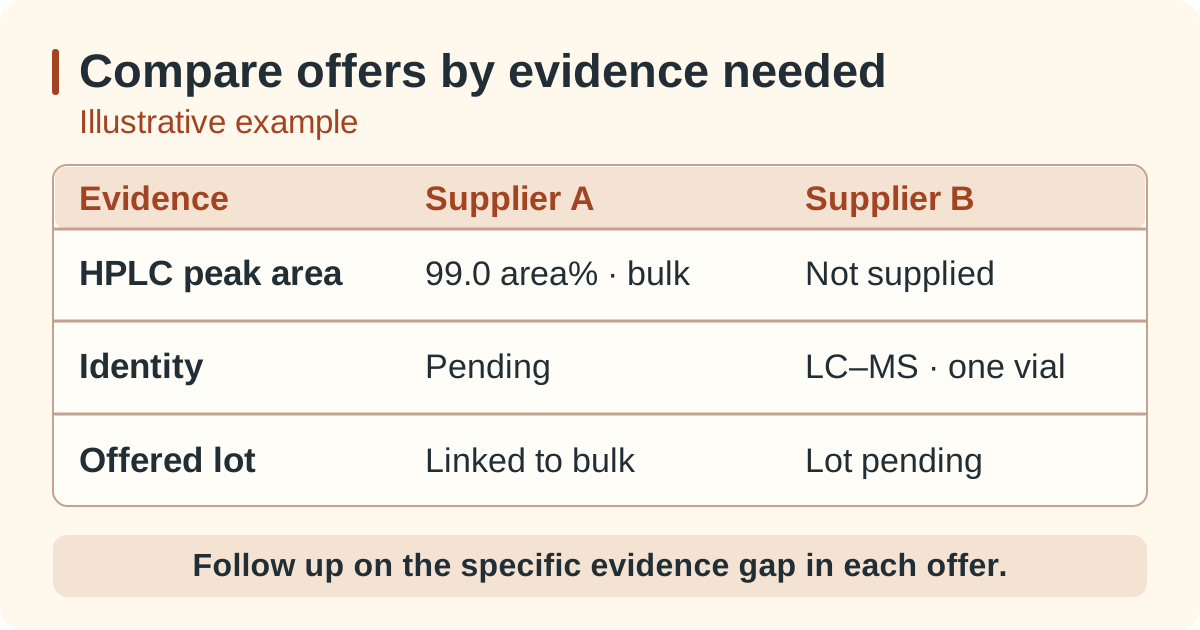
Compare the measured attributes only after checking the sample, method and reporting basis. The HPLC/UV area result in this example describes relative signal for a retained bulk specimen. The LC–MS report concerns a different submitted vial. If both suppliers later provide a quantitative assay, check the chemical basis and whether each result covers one vial or a defined set of vials.
In this fictional comparison the study requires a confirmed shipping lot, identity evidence tied to that lot, and a measured peptide amount in mg per finished vial on a common peptide-moiety basis. An HPLC area result is recorded as supporting information about the material tested.
| Study requirement | A · Statement and record | A · Decision and follow-up | B · Statement and record | B · Decision and follow-up |
|---|---|---|---|---|
| Confirm the lot to be shipped | Quote A-Q42 names A-042. Release record A-REL42 and the lab intake record map retained bulk specimen A-S42 to that lot. | Documented for the quoted lot. Check the received label against the quote. | Quote B-Q31 says “lot to be assigned at release.” Lab report R-116 names submitted vial V-03 and leaves the supplier lot unspecified. | Open. Request the released shipping lot and a record linking its lot or specimen to V-03, or a report on an identified sample from that lot. |
| Obtain identity evidence for the offered material | The catalog names the peptide. HPLC report A-CH42 gives relative area for retained bulk A-S42. | Open. Request a suitable identity report and the corresponding sample mapping for A-042. | R-116 reports an LC–MS mass match for V-03, a vial submitted by the supplier. | Evidence for the submitted vial only. Obtain a documented sample-to-lot link and review the identity procedure against the study requirement. |
| Obtain measured peptide equivalent per finished vial | The offer describes a nominal vial amount. A-CH42 reports 99.0 area % by HPLC/UV for retained bulk A-S42. | Open. Request a calibrated mg-per-vial assay for the offered lot, with the reporting basis and sampled units. | The catalog states “5 mg per vial.” R-116 supplies no quantitative assay. | Open. Record 5 mg per vial as a supplier claim. Request a calibrated assay for identified finished vials and confirm the chemical basis. |
Offer A has a documented quoted lot. Keep its identity and finished-vial amount requirements open. Offer B also needs a confirmed shipping lot and a specimen link. Record the evidence and assign the remaining requests in the two-offer worksheet.
Document why a gap affects the purchase
For each unresolved row, state what evidence would close it and who owns the follow-up. For example, “Supplier B offered lot pending. Identity report R-116 names vial V-03, lot unknown. Request the lot mapping before counting R-116 as evidence for the offered material.” Keep catalogue screenshots, quotes and report revisions together where they support the decision.
ICH Q7 provides examples of material and supplier records in API manufacturing, and ICH Q2(R2) describes validation considerations for pharmaceutical procedures. In a research purchase, apply the evidence requirements that follow from the experiment. When a new lot arrives, update the recorded identifiers and reopen the affected rows. A previous report is useful historical context, while a fresh lot comparison depends on evidence that applies to that material.
ICH Q7, API GMP guidance, §§ 7, 11.4 and 17 · ICH Q2(R2), Validation of Analytical Procedures, corrected April 2025